

Prabowo Open to Breach Indonesia Deficit Cap Only During Crisis

(Bloomberg) -- President Prabowo Subianto said he would only consider temporarily exceeding Indonesia’s statutory budget deficit cap for emergency situations, adding that he remains committed to fiscal discipline and the nation must “live within our means.”
In an exclusive interview with Bloomberg News at his hilltop residence south of Jakarta, Prabowo said his government would only approve a short-term increase in the deficit beyond 3% of gross domestic product if oil prices stay elevated for a sustained period due to the US-Israel war in Iran. He likened the situation to the Covid-19 pandemic, when Indonesia’s fiscal deficit breached the legal limit for two years to allow for emergency spending.
Calling the deficit cap “a good tool to discipline ourselves,” Prabowo said Indonesia has no plans to revise it “unless there’s a very big emergency like Covid.”
“But I hope that we need not change it,” he told Bloomberg on Saturday in his first major international interview since taking office. “I don’t believe in deficits, actually. Maybe I’m old-fashioned.”
Indonesian lawmakers have capped the deficit at 3% of GDP since the early 2000s, when the nation imposed stronger guardrails on public debt after the Asian financial crisis. The rule has since been closely watched by investors as a cornerstone of the country’s fiscal discipline.
Last week, Coordinating Economic Minister Airlangga Hartarto floated a temporary change in the deficit as one option for dealing with higher oil prices without hurting growth. Finance Minister Purbaya Yudhi Sadewa warned earlier this month that the budget shortfall could widen to as much as 3.6% of GDP if crude prices hit an average of $92 a barrel this year and the country didn’t trim spending. The current budget assumes average prices of $70.
Assets in Southeast Asia’s biggest economy have been under pressure amid persistent fiscal concerns since Prabowo, 74, took power in October 2024. The selloff deepened this year after Fitch Ratings and Moody’s Ratings both lowered Indonesia’s credit rating outlook to negative, citing an erosion of policy certainty and credibility — a characterization his government has disputed.
Prabowo has been looking to supercharge annual economic growth from the current 5% path to 8% by the time his term ends in 2029. He’s betting that pouring large sums of money into low-cost housing, village cooperatives and a free meals program for tens of millions of students and others can help drive that expansion.
Higher oil prices amid the Middle East crisis have clouded that picture, however. Indonesia relies on imports for the bulk of its fuel requirements, and its import bill has risen as the rupiah sits near a record low.
Passing those costs along to consumers has long proved difficult in the world’s fourth most populous nation, where heavily subsidized fuel prices — costing the government billions of dollars each year — are widely seen as an economic entitlement and a symbol of the state’s obligation to share the benefits of its natural resources.
Prabowo’s government pledged to avoid increasing the price of subsidized fuel as Indonesia heads into the Eid al-Fitr holiday this week, when millions of people travel home in one of the world’s largest annual mass migrations. More than 100 million people are expected to be on the move for the holiday this year.
In the interview, Prabowo said he’s confident the government can avoid raising fuel prices, but it would be “very difficult” if oil exceeds $120 per barrel for a long period of time. He said his administration is focused on curbing fuel consumption, and is weighing a four-day work week and more online meetings to reduce its oil demand.
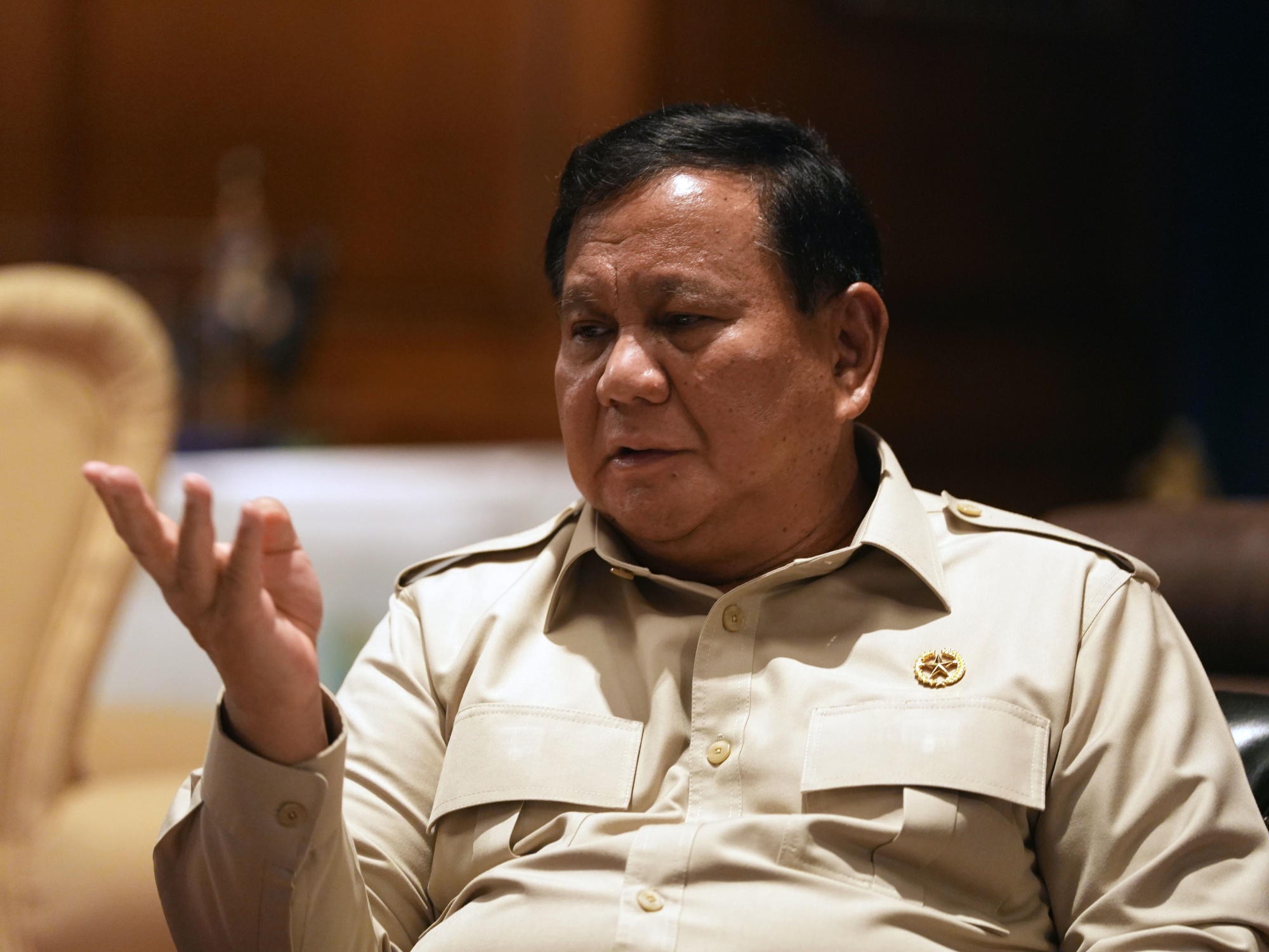
He added that he wouldn’t touch his signature free meals program, calling it a “stimulus for growth at the grassroots level.” The program is designed to feed more than 80 million people on a near-daily basis, and it accounts for 11% of the central government’s budget this year.
Referring to the Iran crisis as a “rude wake-up call,” Prabowo said it would accelerate the shift toward renewable energy. He said his administration is seeking to eliminate costly fuel subsidies over the next three years and replace them with 100 gigawatts of solar power.
“I’m determined to get rid of fuel subsidies,” Prabowo said. “We cannot survive on subsidies in the long run.”
The president said Indonesia was in a “more fortunate situation” than many other countries due to the availability of palm oil and coal, which he said remains cheap and can ensure “national survival.” Indonesia would look to further develop geothermal, solar, hydropower and biofuels, he added.
“If we weather this, in two years we will be very efficient,” Prabowo said. “We will be very, very not dependent on external sources.”
Prabowo underscored his commitment to fiscal discipline, even while noting many other countries have long abandoned strict budget deficit targets. He said Indonesia initially wanted to copy the European Union, but many countries in the bloc no longer adhere to a rule to cap fiscal deficits at 3% of GDP.
Still, he is opposed to economic thinkers who advocate pushing for growth by taking on a lot of debt, saying his parents raised him to believe that “we must live within our means.”
“Do not spend more than you earn,” Prabowo said. “This is the basics of life to survive.”
©2026 Bloomberg L.P.