

R.Power Bets on Battery Storage Boom as Poland Plots Coal Exit

(Bloomberg) -- A European clean power challenger is betting on rapid growth of battery storage in Poland as the country seeks to curb high energy costs and exit coal.
The European Union’s most coal-reliant economy is redesigning its power system to phase out heavily emitting plants and make room for gas, renewables, battery storage and nuclear energy. That’s where Warsaw-based R.Power SA sees abundant business opportunities as it eyes to be ranked among the bloc’s top 10 battery storage operators.
Utility-scale batteries will play a “very important” stabilizing role in countries that are moving away from imported, expensive hydrocarbons and lack alternatives, according to R.Power co-founder and Chief Operating Officer Tomasz Sek.
However, the window for securing the most attractive deals is closing quickly.
“We see this as a window of opportunity, a moment for a market grab,” Sek said in an interview in Warsaw. “Whoever fails to build scale within five years will have very little chance of catching up with the leaders.”
More Resilient
Europe’s battery storage market is poised to surge six-fold to about 400 gigawatt hours by the end of the decade, according to a report by photovoltaic business association SolarPower Europe, which described the continent’s market as key for the EU’s energy security and competitiveness goals. That comes as battery storage costs are tumbling, improving the economics of projects and the resilience of energy infrastructure.
Most of Poland’s coal plants, currently generating more than half of the nation’s electricity, are set to close down in the next 10 to 15 years as the country is undergoing its biggest energy transition in history.
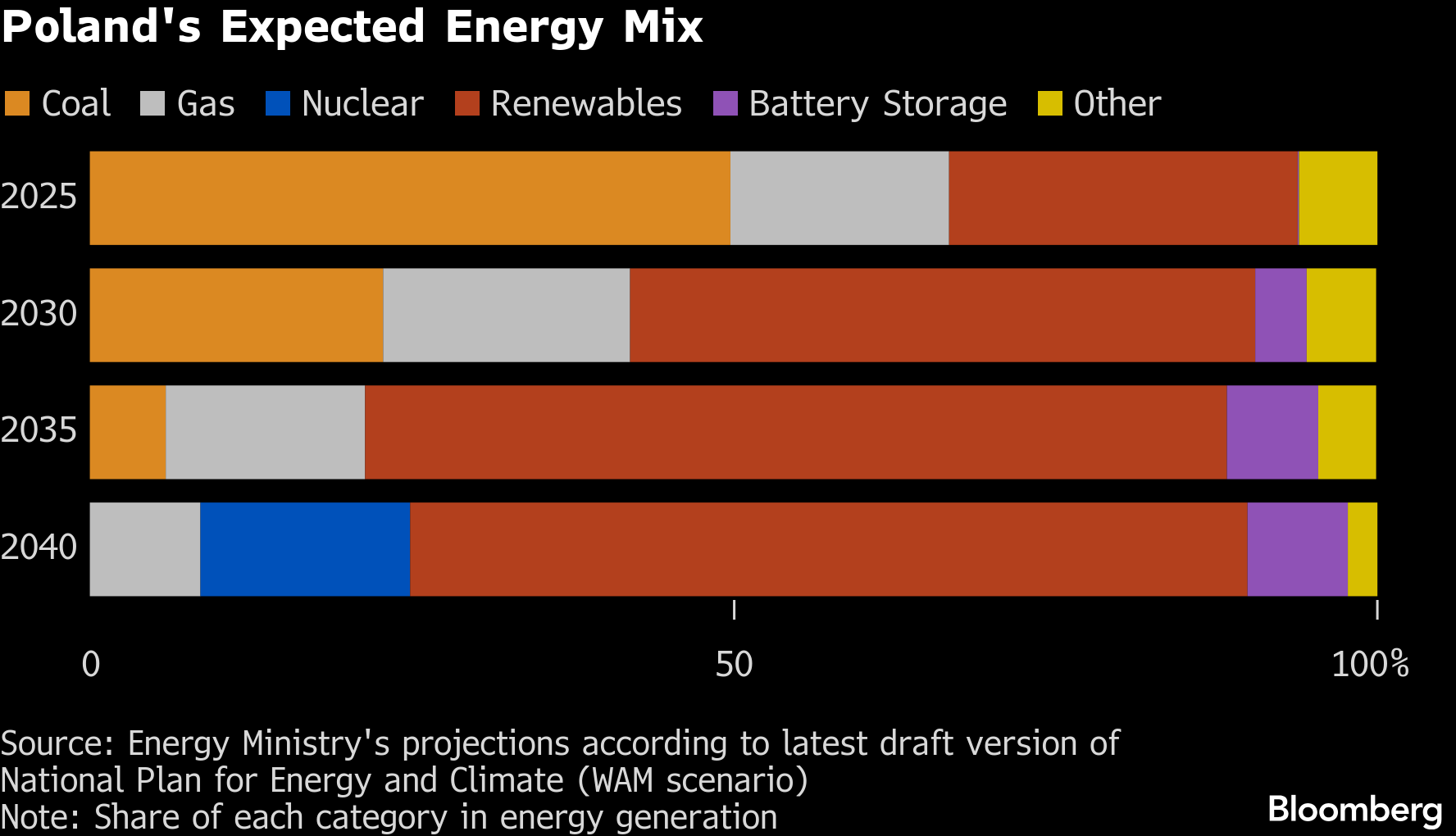
Its energy strategy envisages batteries supplying as much as 7% of total electricity in 2035 from 14 gigawatt of planned capacity. The nation’s biggest utility PGE SA alone plans to have 2 gigawatts in battery storage in the same period, while R.Power has already won state support for projects exceeding 1.7 gigawatts of capacity.
To spur investments in storage, the government in Warsaw has held capacity auctions, a mechanism aimed at awarding payments to entities for keeping their facilities available and propping up the grid.
Busy Market
Privately-held R. Power, which started as solar farm developer 16 years ago, is also investing in Romania, Germany and Italy. The company is navigating an already crowded market in Poland, facing off against both local state-run groups such as PGE and Tauron Polska Energia SA but also foreign rivals.
Spain’s Grenergy Renovables has recently won contracts for 2.1 gigawatts of storage projects in Poland, while Trafigura’s unit Nala Renewables Ltd and German RWE AG secured deals in the capacity market auction. Late last year, Canadian Northland Power Inc. bought large battery projects that also got state support.
For R.Power, Poland’s current market structure with multiple households installations and evening price peaks makes battery storage attractive for investing and arbitrage. Eventually, a growing share of batteries in the system may absorb excess of solar generation during the day and flatten the price profile, the COO said.
He expects demand for electricity to rise, driven by data centers as well as cloud and AI services. The mix of renewable energy sources is already helping the firm cut prices for corporate clients under long-term electricity purchase agreements to levels well below those on the spot market.
“Its ‘green’ nature is not the main draw,” Sek said. “The price is key.”
©2026 Bloomberg L.P.