

China Vows to Hit Carbon Peak Even With Wary New Climate Plan

(Bloomberg) -- China, the world’s top polluter, set a cautious new five-year climate target, frustrating hopes for tighter policy that would drive the nation to peak carbon emissions well before President Xi Jinping’s 2030 deadline.
A new goal pledges to cut carbon emissions per unit of gross domestic product by 17% by the end of the decade, and compares to a previous objective to deliver an 18% reduction in the five years through 2025 — which annual reports said was narrowly missed.
“We will actively yet prudently work toward peaking carbon emissions and achieving carbon neutrality,” Premier Li Qiang said Thursday at the National People’s Congress, the once-a-year gathering of policymakers which set a modest new growth target and acknowledged rising geopolitical risks. China will balance “economic and social development, the green and low-carbon transition, and national energy security,” Li said.
Officials held back from a strict limit for the nation’s emissions and dashed expectations that target years would be set to top out consumption of coal and oil. The cautious strategy reflects China’s recent tone on climate action that is prioritizing the development of green industries, rather than aggressive emissions curbs.
Xi’s goal to reach a carbon peak before 2030 will be “accomplished as planned,” and a system of controlling the total volume of emissions — in addition to intensity targets — will also be implemented, according to Li’s annual work report.
China’s approach is to “scale up clean energy and clean-tech industries, relying on falling costs and increasing supply of clean energy to drive down emissions, rather than focusing on strong measurable emission targets,” said Lauri Myllyvirta, lead analyst for the Centre for Research on Energy and Clean Air, or CREA.
Action over the next five years will be crucial in determining whether China meets Xi’s carbon emissions deadline and gets on track to hit net zero by 2060. How quickly and aggressively the country can begin to reduce its outsized climate footprint is also critical to the world’s prospects of limiting the impacts of global warming.
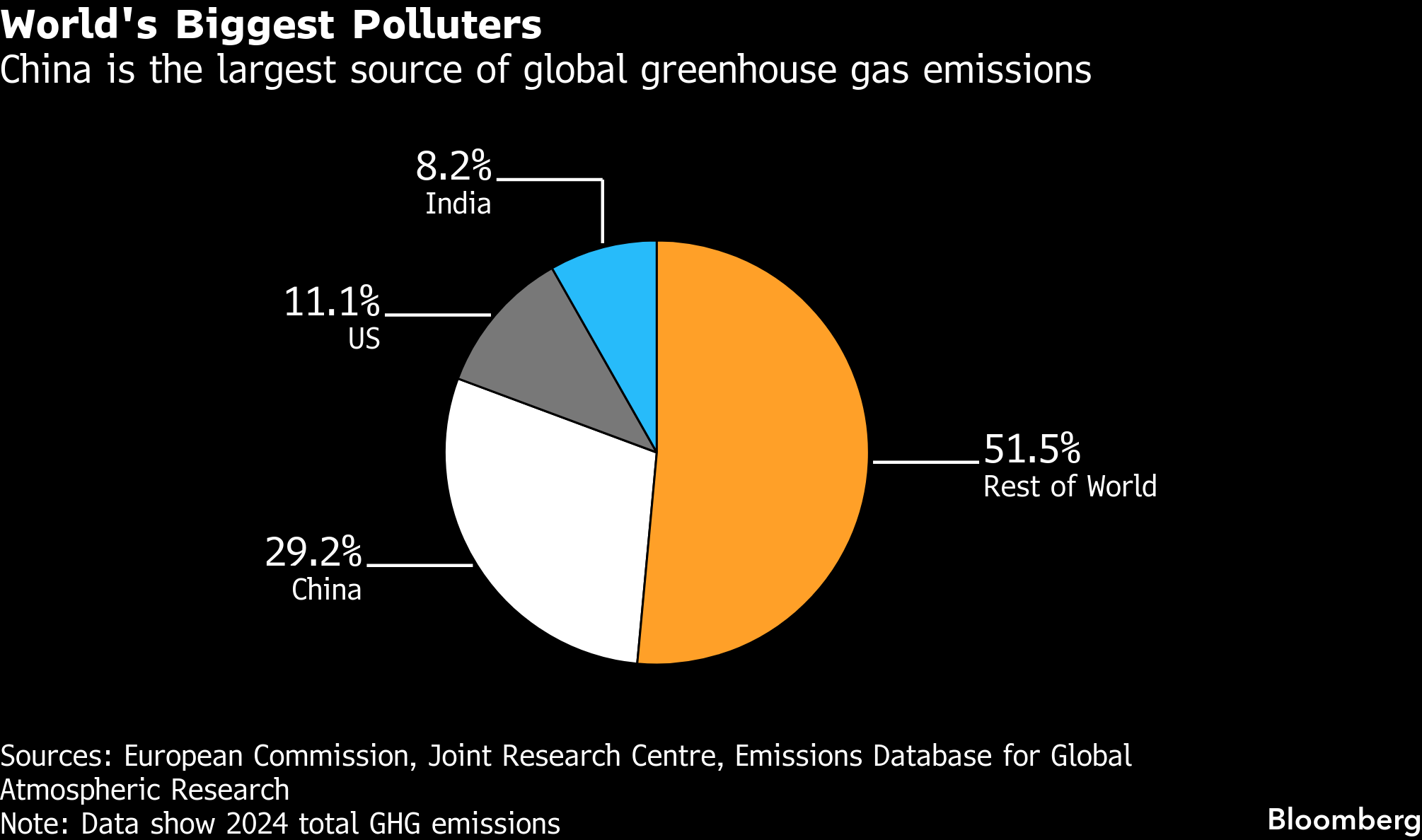
China accounted for about 29% of greenhouse gas pollution in 2024, compared to the 11% contributed by the US — the second-ranked nation. Since then, the US has revoked climate policies under President Donald Trump and saw emissions edge up last year, according to an analysis by Rhodium Group.
Efforts by China to lay out climate objectives through 2035 in a report lodged with the United Nations last year shows its “commitment as a responsible major country,” the work report said. Critics have argued that strategy, which pledged a 7% to 10% cut in total greenhouse emissions, is too easily achievable.
China also aims to “actively participate in and lead global climate governance,” according to a draft text of the country’s 15th five-year plan, and will continue to back the UN Framework Convention on Climate Change and the Paris Agreement — both of which the US has exited.
Reports issued by China’s ministries made other commitments across a range of areas, including pledges to double non-fossil fuel energy over 10 years, to continue the issuance of sovereign green bonds, to toughen environmental laws, and to support green manufacturing or zero-emissions industrial hubs.
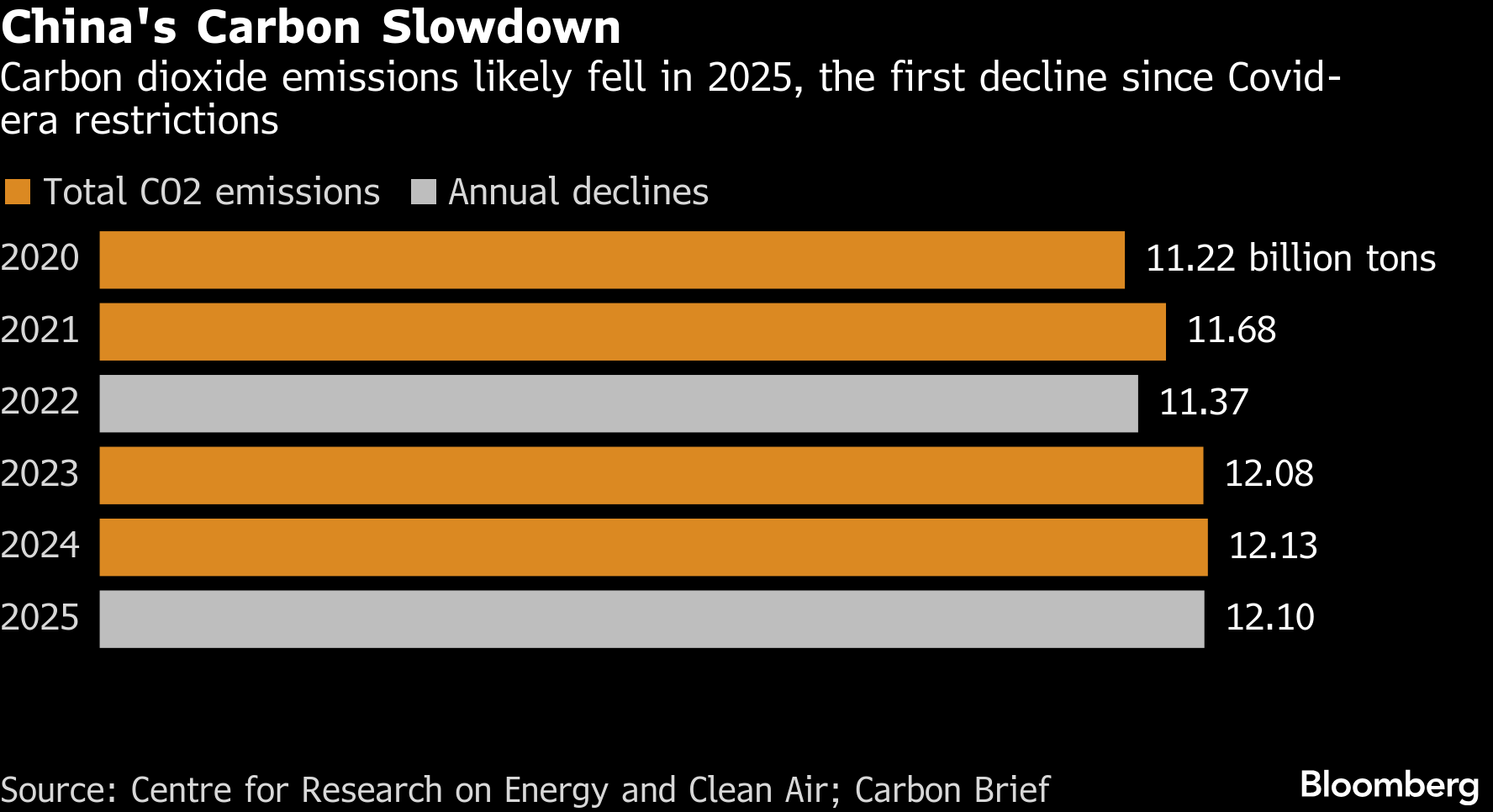
There have been recent signs of climate progress in China. Carbon emissions likely fell 0.3% in 2025, a first decline since Covid-era curbs, CREA said last month. World-leading adoption of renewable energy means China is now meeting growing electricity consumption without the need to burn more coal, while the dramatic rise of EVs has eroded demand for transport fuels.
Even so, China’s emissions trajectory over the coming years remains in question, as the country continues to break ground on new coal-fired power stations and carbon-intensive chemical plants.
“Easier gains have largely been captured,” said Muyi Yang, senior energy analyst, Asia at think tank Ember. “The focus increasingly shifts to more challenging areas — decarbonizing hard-to-abate sectors, integrating a much larger share of renewables into the power system, and building a more flexible and resilient electricity system.”
The new carbon emissions intensity target — which includes a goal for a 3.8% reduction this year — may be calculated using a different methodology than in the past. On Saturday, China’s National Bureau of Statistics said it included emissions both from the energy sector and industrial processes in its methodology, whereas in previous years it didn’t specify emissions sources. Explicitly including industrial pollution will allow China to book reductions from the huge drop in cement production due to the property crisis.
Using the previous methodology, CREA last month calculated that China had reduced its emissions intensity by about 12% from 2021 to 2025. The government’s reports Thursday said China had achieved a 17.7% cut.
That difference is significant as it shows the scale of China’s challenge to meet a commitment under the Paris accord to reduce emissions intensity 65% by 2030 from 2005 levels. Under the previous methodology, CREA had estimated China would need to achieve a 23% drop over the next five years, whereas the government insisted its new strategy is in line with its Paris goals.
(Updates with additional detail throughout)
©2026 Bloomberg L.P.