

European Gas Jumps 28% as Middle East War Threatens Global Flows

(Bloomberg) -- European natural gas surged after fighting across the Middle East raised fears of a major disruption to global energy supplies, with traders watching how long ship traffic through the Strait of Hormuz will remain halted.
Benchmark futures jumped as much as 28% — the biggest increase since August 2023 — after tankers largely stopped traversing the narrow waterway over the weekend. It’s a key shipping route for energy, carrying about a fifth of the world’s liquefied natural gas exports. Oil also rose sharply.
The situation risks the most serious shock to gas markets since Russia’s invasion of Ukraine four years ago upended global energy trade. While Asian countries buy most of the LNG shipped from the Middle East, any disruption would increase competition for alternative supplies — pushing up prices worldwide, including in Europe.
Europe is especially exposed. While the continent is nearing the end of winter and gas consumption is slowing, fuel inventories are unusually low. The region needs to import large volumes of LNG this summer to refill them ahead of next heating season, and “the next key question for traders will be how long the strait remains closed,” said Tom Marzec-Manser, director for Europe gas and LNG at Wood Mackenzie Ltd.
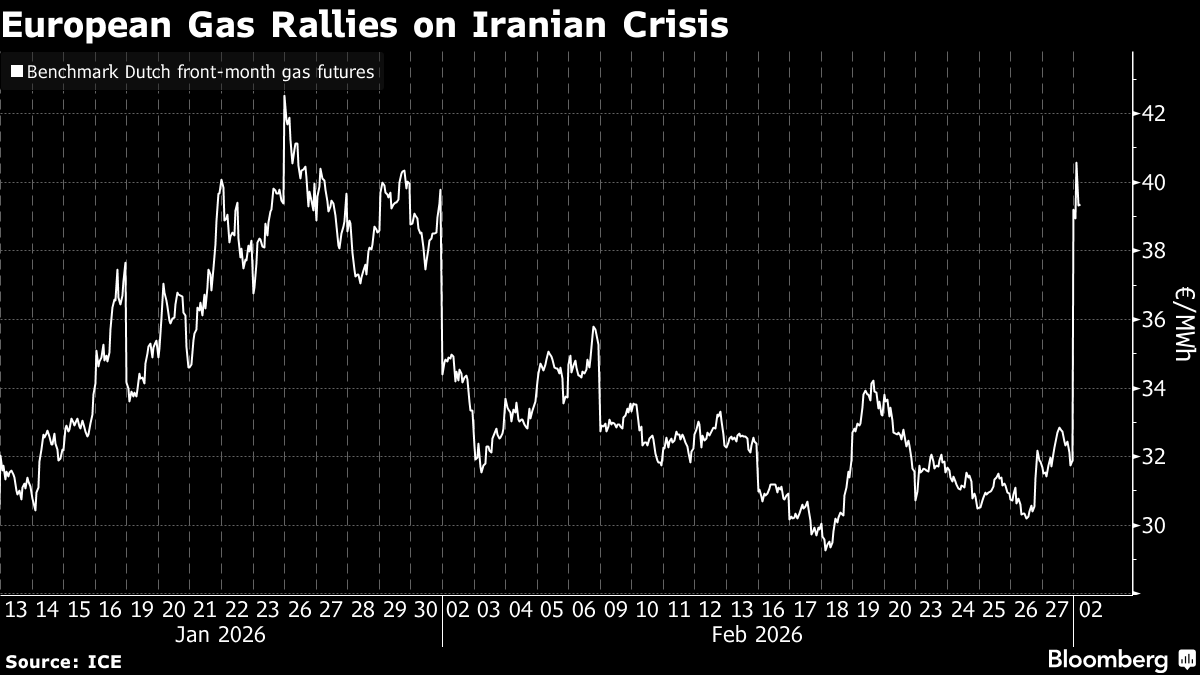
“The longer it takes to reopen the higher the price will go,” he said. US President Donald Trump said in an interview with the New York Times that he intends for the bombardment of Iran to continue for the next four to five weeks.
Meanwhile, more than half of the world’s largest maritime insurance clubs will cease covering war risks for ships entering the Persian Gulf starting Thursday, Bloomberg reported. The removal of the insurance will likely dent risk appetite for those looking to load cargoes from within the Persian Gulf.
A month-long halt to shipping through Hormuz could cause European gas prices to more than double, according to Goldman Sachs Group Inc. That would mark a significant shock for the market after benchmark futures dropped 19% last month, thanks to relatively mild weather and ample supply.
“This situation might complicate storage refill operations in the coming months, and place renewed pressure on industrial energy costs,” said Simone Tagliapietra, an analyst at the Bruegel think tank in Brussels.
The conflict intensified over the weekend after the US and Israel attacked Iran. Tehran responded with strikes targeting several countries. LNG tankers that were scheduled to load cargoes in Qatar and the United Arab Emirates now appear to be delaying or rerouting their plans, and Qatar has temporarily cut the number of staff working at the world’s biggest LNG export plant.
In addition, Israel on Saturday ordered the temporary closure of some gas-producing capacities as a security measure, prompting major importer Egypt to seek more LNG cargoes. Israel has three projects, including the large Leviathan gas field, which was also shut down as a precaution when Israel and Iran were at war in June.
Gas trade disruptions in the Middle East could also eventually raise spot LNG demand from Turkey, according to BloombergNEF, as it imports pipeline fuel from Iran.
Iran said it didn’t intend to shut the Hormuz waterway, yet vessels began avoiding the strait almost as soon as the conflict began on Saturday. Qatar has announced a temporary suspension of all maritime navigation.
“The European gas marked in reality is more sensitive to the de facto closure of the Strait of Hormuz than the oil market,” said Arne Lohmann Rasmussen, chief analyst at Global Risk Management. “This cut off will soon be felt in the physical market.”
Dutch front-month futures, Europe’s gas benchmark, traded higher at € a megawatt-hour by 10:04 a.m. in Amsterdam.
©2026 Bloomberg L.P.